
Search engines have become one of the most important ways for people to discover information, products, services, businesses, and websites online. Whether someone is searching for an answer to a question, comparing products, looking for a local business, or researching a particular topic, search engines help connect that person with relevant web pages. This is where Search Engine Optimization, commonly known as SEO, becomes important.
If you have ever wondered what is SEO and how it works, the basic idea is straightforward: SEO is the process of improving a website and its content so that search engines can better understand, evaluate, and display the website in relevant search results. Effective SEO can help a website gain greater visibility, attract more qualified visitors, and establish stronger credibility within its subject area.
However, SEO is much more than simply adding keywords to an article. Modern search engine optimization involves content quality, technical website performance, user experience, website structure, links, search intent, authority, and many other factors. A successful SEO strategy therefore requires a comprehensive approach rather than relying on a single technique.
This guide explains what SEO is, how search engines work, the major components of SEO, why SEO is important, and how website owners can develop an effective SEO strategy.
Table of Contents
What Is SEO and How It Works?
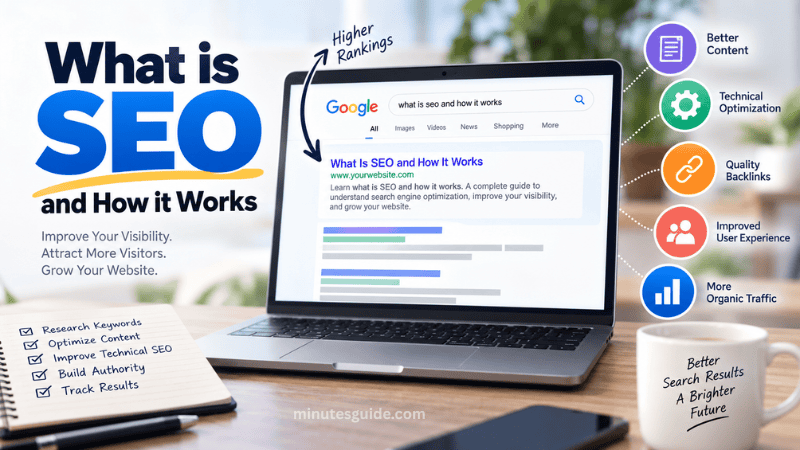
What Is SEO?
SEO stands for Search Engine Optimization. It refers to a collection of practices used to improve the visibility and accessibility of a website or web page in search engine results.
When people enter a query into a search engine, the search engine evaluates numerous web pages to determine which pages are most relevant and useful for that particular search. SEO helps website owners make their websites easier for search engines to discover, understand, and evaluate.
For example, imagine that someone searches for:
how to edit text on any website
A search engine may have thousands or even millions of pages that contain information related to that topic. The search engine must determine which pages provide the most relevant and useful information. SEO helps a website communicate its subject, purpose, structure, and value so that search engines can understand where the page may be appropriate in search results.
SEO does not guarantee that a website will automatically appear in the first position of search results. Search rankings are determined by complex systems that consider many signals, and search engines continually update their systems to improve the quality of their results.
Instead, SEO should be viewed as a long-term process of making a website more useful to both search engines and users.
How Does SEO Work?
SEO works by improving different aspects of a website so that search engines can discover its pages, understand their content, determine their relevance, and potentially rank them for appropriate searches.
Search engines generally perform several important processes when handling web content. These processes include crawling, indexing, and ranking.
Understanding these three concepts makes it easier to understand what is SEO and how it works in practice.
1. Crawling
Crawling is the process through which search engine systems discover web pages and other online resources.
Search engines use automated programs, often called crawlers, bots, or spiders, to visit websites and follow links between pages. These systems collect information about pages so that the search engine can understand what content is available on the web.
For example, a search engine crawler may discover a website through a link from another website. It may then follow internal links to discover the website's homepage, blog posts, category pages, product pages, and other resources.
A website's internal linking structure can therefore play an important role in helping search engines discover its content.
2. Indexing
After discovering a web page, a search engine may process and store information about that page in its index.
An index can be thought of as a massive database containing information about web pages that a search engine has discovered and processed. When a user performs a search, the search engine can use this stored information to identify potentially relevant pages.
Indexing does not necessarily mean that a page will rank highly. A page may be indexed but still receive little or no organic search traffic because it is not considered sufficiently relevant, useful, authoritative, or competitive for particular searches.
Website owners should therefore distinguish between getting a page indexed and achieving strong search visibility.
3. Ranking
Ranking refers to the process of determining the order in which relevant pages appear in search results.
When someone performs a search, the search engine evaluates available information and attempts to present results that are useful for the user's query.
Many factors can influence how pages perform in search results. These can include the relevance of the content, quality and originality of information, page experience, technical accessibility, links, website authority, and the relationship between the content and the user's search intent.
Because search engines use complex ranking systems, there is no single formula that guarantees a particular position.
Why Is SEO Important?
SEO is important because search engines are a major source of online discovery. A website can contain excellent information, products, or services, but it may struggle to attract visitors if potential users cannot easily find it.
A well-developed SEO strategy can help a website become more visible for relevant searches.
SEO Can Increase Organic Traffic
Organic traffic refers to visitors who reach a website through unpaid search engine results.
Unlike paid advertising, organic search traffic does not require a website owner to pay for every individual click. Building organic visibility can therefore become an important component of a long-term digital marketing strategy.
For example, a well-optimized article that ranks for a valuable search query may continue attracting visitors over an extended period.
SEO Can Improve Website Visibility
SEO helps search engines understand what a website is about and which topics its pages cover.
When a website consistently publishes useful and relevant content around a particular subject, it can potentially develop stronger visibility for searches related to that subject.
Greater visibility can expose a business or website to people who are actively searching for the information, products, or services it provides.
SEO Can Attract Relevant Visitors
Not all website traffic has the same value.
A large number of visitors may not be particularly useful if those visitors have no interest in the website's products or information. SEO allows website owners to target topics and search queries that are relevant to their audience.
For example, a website selling running shoes would benefit more from visitors searching for running shoes than from visitors searching for unrelated topics.
SEO Can Support Long-Term Growth
SEO can produce long-term benefits when a website consistently develops useful content, maintains technical quality, and earns credibility.
Unlike a temporary advertising campaign, an organic search result can potentially continue attracting visitors after the initial content has been published. However, rankings can change over time, so websites need to maintain and update their SEO strategies.
The Main Types of SEO
SEO can be divided into several major areas. Although these categories overlap, each one focuses on a different aspect of website optimization.
The four commonly discussed areas are on-page SEO, technical SEO, off-page SEO, and local SEO.
What Is On-Page SEO?
On-page SEO refers to optimization performed directly on individual web pages.
The goal is to make the content clearer, more relevant, useful, and understandable for both visitors and search engines.
Important elements of on-page SEO include titles, headings, content, keywords, URLs, internal links, images, and metadata.
Keyword Optimization
Keywords are words or phrases that people use when searching for information.
Keyword optimization involves naturally incorporating relevant terms into content without making the writing unnatural or repetitive.
For example, if an article targets the keyword "what is SEO and how it works," the phrase may appear naturally in the title, introduction, headings, and relevant sections.
However, excessive keyword repetition can make content difficult to read and may create a poor user experience. Modern SEO therefore focuses more on satisfying the underlying topic and search intent than simply repeating the same keyword.
Search Intent
Search intent refers to the reason behind a user's search.
Someone searching for "what is SEO" is probably looking for an explanation or definition. Someone searching for "best SEO tools" may be comparing software. Someone searching for "SEO agency near me" may be looking for a service provider.
Understanding search intent allows content creators to create pages that answer the actual needs of searchers.
Title Tags
The title of a web page provides search engines and users with an important indication of what the page is about.
A descriptive and relevant title can help users understand the purpose of a page before they visit it.
For example:
What Is SEO and How It Works: A Complete Guide
is more informative than a generic title such as:
Online Marketing Guide
The title should accurately represent the content rather than being designed solely to attract clicks.
Headings
Headings organize content into logical sections.
A clear heading structure makes longer articles easier to read and helps users quickly locate the information they need.
The main title should generally be the page's H1 heading, while major sections can use H2 headings and supporting subsections can use H3 headings.
Internal Links
Internal links connect one page of a website to another page on the same website.
They can help visitors discover related information while also helping search engines understand the relationships between pages.
For example, an article explaining SEO basics could internally link to related articles about keyword research, technical SEO, content optimization, and link building.
Image Optimization
Images can improve the visual quality and usefulness of web pages, but they should also be properly optimized.
Useful image optimization practices include using descriptive file names, appropriate dimensions, suitable file formats, and meaningful alternative text where appropriate.
Optimized images can also contribute to better page performance by reducing unnecessary file sizes.
What Is Technical SEO?
Technical SEO focuses on the technical aspects of a website that affect crawling, indexing, performance, and usability.
A technically strong website makes it easier for search engines to access and process its content.
Important technical SEO considerations include:
- Website speed
- Mobile usability
- Secure HTTPS connections
- Crawlability
- Indexability
- XML sitemaps
- Robots.txt configuration
- Canonical URLs
- Structured data
- Website architecture
- Broken links
- Redirects
- Core Web Vitals and page experience
Technical SEO can become increasingly important as a website grows because large websites may contain thousands or millions of URLs that need to be properly organized and managed.
What Is Off-Page SEO?
Off-page SEO refers to activities that occur outside the website itself and can influence how the website is perceived in terms of authority, relevance, and reputation.
One of the most important aspects of off-page SEO is link building.
When another reputable website links to a page, that link can provide additional context and may contribute to the linked site's overall authority. However, the quality and relevance of links are generally more important than simply acquiring a large number of links.
Effective off-page SEO can involve:
- Earning editorial backlinks
- Publishing useful resources that other websites want to reference
- Digital public relations
- Industry partnerships
- Brand mentions
- Expert contributions
- Building genuine relationships within a relevant industry
SEO should avoid manipulative approaches designed primarily to artificially influence rankings.
What Is Local SEO?
Local SEO focuses on improving visibility for searches associated with a particular geographic location.
It is particularly important for businesses that serve customers within a specific area.
Examples include restaurants, medical practices, repair services, retail stores, hotels, law firms, and other local businesses.
Local SEO can involve maintaining accurate business information, developing location-specific content, managing business listings, earning relevant local links, and encouraging legitimate customer reviews.
For example, someone searching for "coffee shop near me" has a very different search intent from someone searching for "how coffee is produced."
Understanding the geographic intent behind a search allows businesses to optimize their online presence accordingly.
How Keywords Affect SEO
Keywords remain an important part of SEO because they help describe the subjects that users and websites are discussing.
However, successful keyword optimization is not simply about finding a keyword and repeating it many times.
A comprehensive keyword strategy considers several factors, including:
- Search intent
- Relevance
- Search demand
- Competition
- Topic coverage
- User expectations
- Business value
Long-tail keywords can also be valuable because they are often more specific and can reveal clearer user intent.
For example, "SEO" is extremely broad, while "how to improve SEO for a small business website" provides much more information about what the searcher may want.
The Importance of High-Quality Content
Content is one of the central elements of SEO.
Search engines aim to provide users with useful results, which means websites need to produce content that genuinely addresses the needs of their intended audience.
High-quality content should be:
- Relevant to the topic
- Accurate
- Useful
- Original
- Well organized
- Easy to understand
- Appropriate for the intended audience
- Supported by trustworthy information when necessary
Long content is not automatically better content.
An article containing 3,000 words of unnecessary repetition may be less useful than a concise 1,500-word article that directly answers the reader's questions.
The objective should therefore be to provide sufficient depth without adding unnecessary information.
SEO and User Experience
SEO and user experience are closely connected.
A website may have technically optimized content, but if visitors encounter slow pages, confusing navigation, intrusive elements, or difficult-to-read text, the overall experience can suffer.
A good website should make it easy for visitors to:
- Understand what the page is about.
- Navigate to related information.
- Read the content comfortably.
- Complete important actions.
- Find answers without unnecessary obstacles.
A positive user experience can help visitors stay engaged with a website and develop greater trust in its content or business.
SEO vs Paid Search
SEO and paid search can both increase a website's visibility in search engines, but they work differently.
SEO focuses primarily on earning organic visibility, while paid search involves paying for advertising placements.
| SEO | Paid Search |
|---|---|
| Focuses on organic search results | Focuses on paid advertisements |
| Can provide long-term visibility | Can provide immediate visibility |
| Does not require payment for every organic click | Typically involves advertising costs |
| Requires ongoing content and technical optimization | Requires ongoing advertising budget |
| Results can take time to develop | Campaigns can start generating traffic quickly |
| Rankings are not guaranteed | Ad placement depends on campaign settings and auction systems |
Both approaches can be useful, and businesses may choose to combine SEO with paid search depending on their goals and resources.
Common SEO Mistakes to Avoid
Understanding what is SEO and how it works also means understanding common mistakes that can limit results.
Keyword Stuffing
Keyword stuffing occurs when keywords are inserted excessively or unnaturally into content.
This can make articles difficult to read and may create a poor experience for visitors.
Keywords should be used naturally when they help communicate the topic.
Publishing Low-Quality Content
Publishing large quantities of shallow or repetitive content does not automatically improve SEO.
Every page should provide a clear reason for existing and should offer useful information to its intended audience.
Ignoring Technical SEO
A website can have excellent content but still experience problems if important pages cannot be properly crawled or indexed.
Technical problems should therefore be monitored alongside content development.
Buying Manipulative Links
Acquiring links solely to manipulate search rankings can create risks and may violate search engine guidelines.
A stronger approach is to create useful content and build legitimate relationships that naturally result in references and links.
Neglecting Mobile Users
A significant portion of internet activity takes place on mobile devices.
Websites should therefore provide a responsive and usable experience across different screen sizes.
Expecting Immediate Results
SEO usually requires patience.
New websites and newly published pages may take time to gain visibility, particularly when competing against established websites with strong authority and extensive content.
How to Create an SEO Strategy
An effective SEO strategy begins with understanding the website's audience, goals, and competitive environment.
A practical process can include the following steps.
Step 1: Define Your Target Audience
Determine who you want to reach and what information, products, or services they are looking for.
A clear understanding of your audience makes it easier to choose appropriate topics and keywords.
Step 2: Perform Keyword Research
Identify search terms that are relevant to your website and audience.
Instead of focusing exclusively on high-volume keywords, consider whether the search terms match your website's purpose and whether you can create genuinely useful content around them.
Step 3: Analyze Search Intent
Study the types of pages that appear for your target queries.
Look at whether search results primarily contain informational articles, product pages, category pages, videos, local results, or other formats.
This can provide clues about what searchers expect to find.
Step 4: Create Useful Content
Develop comprehensive content that answers the user's questions and provides meaningful value.
Avoid creating pages simply because a keyword appears popular. The content should have a clear purpose and satisfy a genuine information need.
Step 5: Optimize the Website
Review technical factors such as site speed, mobile usability, crawlability, indexing, navigation, URLs, internal links, and structured data where appropriate.
Step 6: Build Authority
Promote useful content and develop legitimate relationships with relevant websites, organizations, journalists, creators, and industry communities.
The objective should be to build genuine credibility rather than artificially manipulating rankings.
Step 7: Measure Performance
SEO should be treated as an ongoing process.
Website owners can monitor metrics such as organic traffic, impressions, clicks, rankings, conversions, indexed pages, and engagement to understand what is working and where improvements may be needed.
How Long Does SEO Take to Work?
One of the most common questions about SEO is how long it takes to produce results.
There is no universal timeline because SEO performance depends on many factors.
These factors can include the age and authority of the website, competition within the industry, content quality, technical condition, backlink profile, search demand, and the effectiveness of the overall strategy.
A new website competing against highly established websites may require considerable time and consistent effort before achieving strong visibility.
SEO should therefore be considered a long-term investment rather than a quick technique for generating traffic.
How to Measure SEO Success
Measuring SEO performance helps determine whether optimization efforts are producing meaningful results.
Important metrics can include:
Organic Traffic
Organic traffic measures visitors who arrive through unpaid search results.
Increasing organic traffic can indicate that a website is gaining greater visibility, although traffic quality should also be considered.
Search Impressions
Impressions indicate how frequently pages are displayed in search results.
An increase in impressions can indicate that a website is becoming visible for a wider range of searches.
Organic Clicks
Clicks measure how many users select a website's result from search results.
Comparing impressions and clicks can provide useful information about search visibility and how effectively search-result listings attract users.
Conversions
Conversions are often more important than traffic alone.
Depending on the website, a conversion might involve making a purchase, submitting a contact form, signing up for a newsletter, downloading a resource, or completing another valuable action.
The Future of SEO
SEO continues to evolve as search engines become increasingly sophisticated and users change how they search for information.
Search engines increasingly rely on advanced systems to understand language, context, intent, relationships between concepts, and the overall quality of information.
Artificial intelligence is also changing how people discover and consume information online.
Despite these changes, many fundamental principles remain important. Websites still need to provide useful information, maintain accessible technical foundations, demonstrate credibility, and serve their audiences effectively.
The future of SEO is therefore unlikely to be based on a single trick or shortcut. Instead, successful websites will need to focus on creating genuinely useful experiences while ensuring that their content can be effectively discovered and understood.
Final Thoughts on What Is SEO and How It Works
Understanding what is SEO and how it works is essential for anyone who wants to build a successful website or increase organic visibility online.
SEO is a broad discipline that combines content optimization, keyword research, technical improvements, website structure, user experience, internal linking, authority building, and ongoing performance analysis.
Search engines crawl websites to discover content, process pages for indexing, and use complex ranking systems to determine which results are most relevant to individual searches. SEO helps websites improve their ability to participate effectively in this process.
The most effective SEO strategies do not focus solely on search engines. They focus on creating websites that are genuinely useful to people while making the content accessible and understandable to search engines.
Ultimately, SEO is a long-term process. Consistently publishing valuable content, maintaining a technically sound website, understanding search intent, improving user experience, and building genuine authority can create a stronger foundation for sustainable organic search visibility.
Frequently Asked Questions About SEO
What is SEO and how it works?
SEO, or Search Engine Optimization, is the process of improving a website so that search engines can better discover, understand, and rank its pages for relevant searches. SEO works through several areas, including content optimization, keyword research, technical improvements, internal linking, user experience, and authority building. Search engines crawl and index web pages before determining which results are most relevant to a user's search query.
Why is SEO important for a website?
SEO is important because it can help a website gain greater visibility in organic search results and attract visitors who are actively looking for relevant information, products, or services. A well-optimized website can generate consistent organic traffic over time and support long-term online growth without requiring payment for every organic click.
What are the main types of SEO?
The main types of SEO include on-page SEO, technical SEO, off-page SEO, and local SEO. On-page SEO focuses on content and elements within individual pages, while technical SEO addresses website performance, crawling, indexing, and technical accessibility. Off-page SEO focuses on factors such as backlinks and online authority, while local SEO helps businesses improve visibility for geographically relevant searches.
How do search engines rank websites?
Search engines use complex ranking systems to evaluate web pages and determine which results are most relevant to a particular search. Factors can include content relevance and quality, search intent, website accessibility, technical performance, links, authority, and user experience. There is no single factor that guarantees a particular ranking position.
What is the difference between SEO and paid search?
SEO focuses on improving a website's visibility in unpaid organic search results, while paid search uses advertisements to obtain visibility in search engine results. SEO can provide long-term benefits but may take time to produce significant results. Paid search can generate visibility more quickly, but it requires an ongoing advertising budget.
How long does SEO take to work?
SEO does not have a fixed timeline because results depend on factors such as website authority, competition, content quality, technical condition, industry, and search demand. New websites may require considerable time and consistent effort to establish visibility, while established websites may see improvements sooner. SEO should generally be approached as a long-term strategy rather than a quick solution.
Is keyword research still important for SEO?
Yes, keyword research remains useful because it helps identify the terms and questions that people use when searching for information. However, effective SEO should not rely on repeatedly inserting keywords into content. Website owners should consider search intent, relevance, topic coverage, and the needs of the intended audience when developing content.
What is on-page SEO?
On-page SEO refers to optimization performed directly on a web page. It can include optimizing titles, headings, content, URLs, internal links, images, and other page elements. The objective is to make the page easier for both users and search engines to understand while ensuring that it provides useful information related to the searcher's needs.
What is technical SEO?
Technical SEO focuses on the technical foundations of a website. It can include improving website speed, mobile usability, crawlability, indexability, site architecture, XML sitemaps, canonical URLs, redirects, structured data, and other technical elements. A technically sound website makes it easier for search engines to access and process its content.
Can SEO guarantee a first-page or first-position ranking?
No, SEO cannot guarantee a specific search ranking. Search engine rankings depend on complex systems and can change as search engines update their algorithms, competitors improve their websites, and user behavior changes. A strong SEO strategy can improve a website's ability to compete for relevant searches, but no legitimate SEO method can guarantee a particular position.
Does SEO require backlinks?
Backlinks can be an important part of SEO because links from relevant and reputable websites can contribute to a website's authority and credibility. However, SEO success does not depend solely on backlinks. High-quality content, technical performance, relevance, search intent, user experience, and other factors also contribute to a website's overall search performance.
How can I measure the success of an SEO strategy?
SEO performance can be evaluated using metrics such as organic traffic, search impressions, organic clicks, keyword visibility, indexed pages, and conversions. Conversions are particularly important because they help determine whether search traffic is producing meaningful outcomes, such as purchases, inquiries, registrations, or other valuable actions.
References
- What Is SEO and How Does it Work? - digitalmarketinginstitute.com
- What is SEO? A complete guide to search engine - semrush.com