
Ranking higher on Google is one of the most effective ways to increase organic traffic, attract potential customers, build brand visibility, and grow a website without relying entirely on paid advertising. However, achieving strong Google rankings requires more than simply publishing articles and adding keywords. Search engines evaluate many different signals when determining which pages deserve to appear prominently in search results.
If you want to understand how to rank higher on Google, it is important to approach SEO as a long-term process rather than a one-time activity. A successful SEO strategy combines high-quality content, keyword research, search intent optimization, technical performance, backlinks, user experience, and continuous improvement.
Google's search algorithms are also constantly evolving. Strategies that may have worked several years ago may no longer produce the same results today. For this reason, website owners need to focus on creating genuinely useful content and building websites that provide a strong experience for visitors.
This guide explains 15 proven SEO strategies that can help improve your website's visibility in Google search results. Whether you are managing a personal blog, business website, online store, affiliate website, or professional publication, these strategies can provide a practical foundation for improving organic search performance.
Table of Contents
How to Rank Higher on Google: 15 Proven SEO Strategies
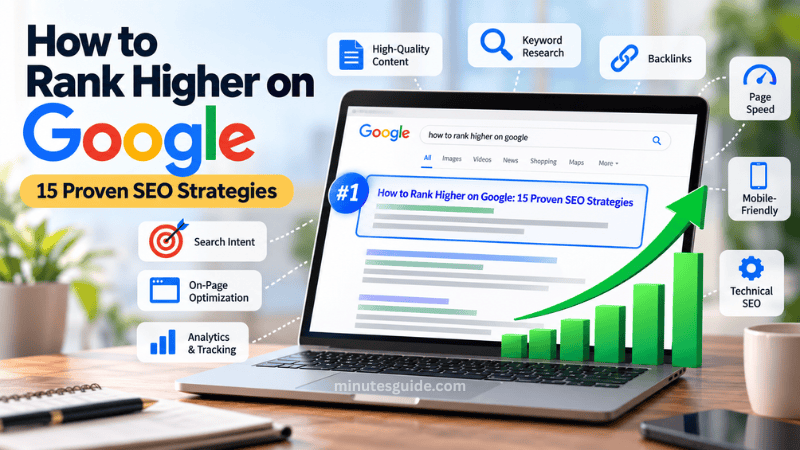
What Does It Mean to Rank Higher on Google?
Ranking higher on Google means having your webpage appear closer to the top of Google's organic search results for relevant search queries. For example, if someone searches for "how to rank higher on Google," a page appearing in the first few organic results has a greater opportunity to receive clicks than a page appearing on the second or third page.
Higher rankings can potentially lead to more impressions, clicks, website visitors, leads, sales, and brand exposure. However, ranking position alone does not guarantee success. Your title, description, content quality, search intent, and overall reputation can all influence whether users choose your page.
SEO should therefore focus on two objectives: helping search engines understand your content and providing users with the information they are actually looking for.
15 Proven Strategies on How to Rank Higher on Google
1. Conduct Thorough Keyword Research
Keyword research is one of the fundamental components of SEO. Before creating an article or landing page, you should identify the words and phrases that your target audience is actually using when searching for information, products, services, or solutions.
Instead of choosing keywords based only on search volume, consider the purpose behind each search. A keyword with a large search volume may be highly competitive and difficult to rank for, while a more specific long-tail keyword may attract fewer searches but generate visitors who have a clearer intention.
For example, instead of targeting a broad keyword such as "SEO," a new website might target a more specific phrase such as "how to rank higher on Google for beginners." The longer keyword may have lower search volume, but it can provide a clearer indication of what the searcher wants to learn.
Useful keyword research should consider search volume, competition, relevance, search intent, related terms, and the type of content currently ranking for the keyword.
2. Understand Search Intent
Understanding search intent is essential if you want to know how to rank higher on Google consistently. Search intent refers to the reason behind a person's search query.
A user searching for "best laptops for students" is probably researching products, while someone searching for "buy MacBook Air" may already be closer to making a purchase. Similarly, someone searching for "how to change a WordPress password" is looking for instructional content.
Search intent is commonly divided into several categories, including informational, navigational, commercial investigation, and transactional intent.
Your content should match the dominant intent behind the target keyword. If Google predominantly displays detailed tutorials for a particular query, publishing a short promotional page may struggle to compete because it does not satisfy what searchers are looking for.
Before writing content, examine the search results and determine what users appear to expect. Look at the format, depth, topics, and purpose of pages that already perform well.
3. Create High-Quality, Helpful Content
High-quality content remains one of the most important elements of a successful SEO strategy. Your content should provide useful information, answer the reader's questions, explain concepts clearly, and offer meaningful value rather than simply existing to target keywords.
A strong article should be comprehensive enough to address the important aspects of a topic without adding unnecessary information merely to increase word count.
For example, if you are writing about how to rank higher on Google, readers may expect information about keyword research, content quality, technical SEO, internal links, backlinks, page speed, mobile usability, and performance measurement.
However, comprehensiveness does not mean making every article extremely long. The appropriate length depends on the topic and what users need. A 1,000-word article that completely answers a simple question can be more useful than a 3,000-word article filled with repetitive information.
Focus on usefulness, accuracy, clarity, originality, and completeness.
4. Optimize Your Page Title
The page title is an important element because it helps both search engines and users understand what a webpage is about. It can also influence whether a person decides to click on your result.
A good SEO title should accurately describe the page and naturally incorporate the primary keyword when appropriate.
For example:
"How to Rank Higher on Google: 15 Proven SEO Strategies"
is more descriptive than:
"SEO Tips"
The first title immediately communicates the subject, benefit, and scope of the article.
Avoid creating titles that are misleading, excessively repetitive, or stuffed with keywords. Your title should be written primarily for people while making the topic clear to search engines.
5. Write Compelling Meta Descriptions
A meta description is a short summary that can appear beneath a webpage title in Google's search results. Although meta descriptions are not generally considered a direct ranking factor, an informative and compelling description can help communicate the value of your page to potential visitors.
A good meta description should summarize what the page provides and encourage relevant users to investigate further.
For example, an article targeting the keyword "how to rank higher on Google" could explain that the page covers 15 practical SEO strategies, including keyword research, technical optimization, content creation, internal linking, and backlinks.
Avoid keyword stuffing and misleading descriptions. The description should accurately represent the content available on the page.
6. Improve Your Website's Page Experience
A website should be easy and comfortable to use. Visitors should be able to navigate the page without unnecessary interruptions, confusing layouts, or excessive loading delays.
Important aspects of page experience include mobile usability, page loading performance, navigation, readability, accessibility, and intrusive elements.
Google also provides Core Web Vitals as a set of measurements related to loading performance, responsiveness, and visual stability.
Improving these technical aspects can benefit both SEO and visitors. A fast and stable website reduces friction and makes it easier for users to consume your content.
You should regularly test important pages, particularly pages receiving substantial organic traffic. If a page loads slowly or has usability problems, investigate the underlying technical causes rather than simply adding more content.
7. Make Your Website Mobile-Friendly
A significant proportion of web searches occur on mobile devices, making mobile usability an essential consideration for modern websites.
Your website should adapt properly to different screen sizes and allow users to read content, click buttons, navigate menus, and complete important actions without excessive zooming or horizontal scrolling.
A mobile-friendly website should also maintain reasonable performance on mobile connections and devices.
When reviewing your website, do not only test it on a desktop computer. Open your pages using different mobile devices or browser testing tools and examine the actual user experience.
Pay particular attention to font size, navigation menus, images, forms, buttons, advertisements, pop-ups, and page loading performance.
8. Build a Strong Internal Linking Structure
Internal links connect one page on your website to another page on the same website. They can help users discover additional information while helping search engines understand the relationships between different pages.
For example, an article about keyword research could link to another article explaining how to create SEO-friendly content. An article about WordPress speed optimization could link to a detailed guide about image compression.
A good internal linking strategy creates logical connections between related topics.
Use descriptive anchor text that gives readers a reasonable idea of what they will find after clicking. Avoid creating excessive links simply for SEO purposes.
Internal links can also help distribute authority throughout your website and make important pages easier for search engines to discover.
9. Optimize Your URLs
A clean and descriptive URL can make a webpage easier for users and search engines to understand.
For example:
example.com/how-to-rank-higher-on-google/
is generally clearer than a URL containing a long string of unnecessary parameters or unrelated characters.
Keep URLs concise and relevant to the page topic. Where appropriate, include the primary topic or keyword naturally.
Avoid changing URLs unnecessarily after a page has already been indexed and accumulated links. If a URL must be changed, implement the appropriate redirects to preserve the connection between the old and new addresses.
10. Optimize Images Properly
Images can improve the readability and visual appeal of an article, but poorly optimized images can negatively affect website performance.
Large image files can increase page loading times, particularly for visitors using mobile connections. Before uploading images, resize them to appropriate dimensions and use suitable modern image formats where practical.
You should also use meaningful file names and descriptive alternative text when the image serves an informative purpose.
For example, an image file named:
google-seo-strategy.jpg
is generally more descriptive than:
IMG_83921.jpg
However, image optimization should not involve inserting keywords into every image file name or alt attribute. Alternative text should accurately describe the image and its purpose.
11. Earn High-Quality Backlinks
Backlinks are links from other websites pointing to your website. They can help search engines discover pages and, when earned from reputable and relevant websites, can contribute to your site's authority and credibility.
However, not all backlinks have equal value.
A natural link from a respected website that discusses the same subject can be much more meaningful than a large number of irrelevant or low-quality links.
Instead of trying to acquire as many links as possible, focus on creating content that other websites have a genuine reason to reference.
You can earn backlinks by publishing original research, useful statistics, detailed guides, unique resources, expert commentary, case studies, tools, and other valuable materials.
Avoid manipulative link-building practices designed solely to influence rankings. Sustainable SEO focuses on earning legitimate references rather than manufacturing artificial popularity.
12. Strengthen Your Website's Authority and Trustworthiness
Google needs to determine whether content can be trusted and whether it is appropriate for the search query. This is particularly important for topics that can significantly affect people's health, finances, safety, or well-being.
Demonstrate credibility by providing accurate information, identifying appropriate authors or contributors where relevant, citing reliable sources when necessary, and keeping important information up to date.
For business websites, clearly provide information about the organization, contact methods, policies, services, and other relevant details.
For informational websites, make it easy for readers to understand who created the content and why that person or organization is qualified to discuss the subject when qualifications are relevant.
Trust is not created by adding a badge or a single sentence to a webpage. It is developed through the overall quality, transparency, accuracy, and reputation of a website.
13. Update and Improve Existing Content
Publishing new articles is not the only way to grow organic traffic. Existing content can often be improved substantially through regular review.
Some older articles may contain outdated information, broken links, obsolete screenshots, inaccurate statistics, or sections that no longer satisfy current search intent.
Review your existing pages and identify opportunities to improve them.
You might add missing information, replace outdated examples, improve headings, update statistics, strengthen internal links, improve images, clarify confusing explanations, or remove unnecessary sections.
Content updates should be meaningful rather than performed simply to change the publication date.
If a page already receives organic traffic and has established backlinks, improving it can be particularly valuable because you are building on an existing asset.
14. Use Google Search Console and Analytics Data
SEO should be measured using actual performance data rather than assumptions.
Google Search Console can provide valuable information about how your website appears in Google Search, including impressions, clicks, click-through rates, queries, and average search positions.
This data can reveal opportunities that may otherwise be difficult to identify.
For example, a page might receive many impressions for a keyword but relatively few clicks. This could indicate an opportunity to improve the title and search-result presentation.
Another page might rank around positions 8 to 20 for several related queries. Improving the content, internal linking, and user experience could potentially help the page become more competitive.
Analytics data can also help you understand what visitors do after arriving on your website.
Use these insights to identify opportunities, test improvements, and prioritize your SEO work.
15. Be Consistent and Think Long-Term
SEO is rarely an overnight process. A website may require considerable time to establish authority, accumulate quality content, earn backlinks, and demonstrate consistent value.
This means consistency is essential.
Instead of publishing dozens of low-quality articles in a short period, develop a sustainable content strategy focused on topics that are relevant to your audience.
Create content around your main subject areas and connect related articles through a logical internal linking structure.
Monitor your performance, learn from the data, and continue improving your existing content.
It is also important to understand that rankings can fluctuate. Competitors publish new content, search behavior changes, websites gain or lose links, and search engines continuously improve their systems.
A long-term SEO strategy should therefore emphasize adaptability rather than attempting to find a permanent shortcut.
Common SEO Mistakes to Avoid
Understanding how to rank higher on Google also requires knowing what can prevent your website from performing well.
One common mistake is keyword stuffing. Repeating the same keyword excessively can make content unnatural and difficult to read. Keywords should be incorporated naturally where they help communicate the subject.
Another mistake is producing large quantities of low-quality content without considering whether each page provides genuine value. More pages do not automatically mean better rankings.
Ignoring technical SEO is another problem. Even excellent content can struggle if search engines have difficulty accessing, rendering, or understanding your website.
Website owners should also avoid copying content from other websites. Originality and meaningful value are important components of a sustainable content strategy.
Finally, do not expect backlinks, keywords, or content length alone to guarantee rankings. Google evaluates webpages using many different signals, and no legitimate SEO technique can guarantee a specific ranking position.
SEO Strategy Comparison
| SEO Strategy | Main Purpose | Potential Benefit |
|---|---|---|
| Keyword research | Identify relevant search queries | Better targeting |
| Search intent | Understand user needs | More relevant content |
| Quality content | Provide useful information | Greater organic visibility |
| Title optimization | Clearly communicate topic | Better search-result appeal |
| Meta descriptions | Summarize page content | Improved search-result presentation |
| Page experience | Improve usability | Better visitor experience |
| Mobile optimization | Support mobile users | Better accessibility |
| Internal linking | Connect related pages | Improved navigation and discoverability |
| URL optimization | Create clear page addresses | Better understanding and usability |
| Image optimization | Improve media performance | Faster page loading |
| Backlinks | Earn external references | Greater authority and discovery |
| Website trust | Demonstrate credibility | Stronger overall reputation |
| Content updates | Maintain relevance | Improved content quality |
| Search Console analytics | Measure performance | Better SEO decisions |
| Consistent SEO | Support long-term growth | Sustainable organic traffic |
How Long Does It Take to Rank Higher on Google?
The time required to improve Google rankings varies considerably between websites and keywords.
A new website with little authority may need more time to compete for highly competitive keywords. A well-established website with a strong backlink profile and substantial topical authority may have an easier time gaining visibility for relevant queries.
Other factors include content quality, competition, technical performance, search intent, website history, backlinks, and the quality of competing pages.
For this reason, SEO should not be treated as a guaranteed process with a fixed timetable. Instead, monitor measurable indicators such as impressions, clicks, indexed pages, rankings, organic traffic, and conversions.
Small improvements can accumulate over time and eventually produce significant results.
A Practical SEO Workflow
If you are starting from scratch, you do not need to implement every SEO strategy simultaneously.
Begin by researching your target audience and identifying relevant keywords. Next, group related keywords according to search intent and create useful content that directly addresses those needs.
After publishing the content, optimize the title, URL, headings, images, internal links, and other relevant on-page elements.
Then, review your website's technical performance, mobile usability, and page experience.
As your website grows, develop a strategy for earning relevant backlinks and improving your authority within your subject area.
Finally, use performance data to identify pages that deserve further improvement. SEO becomes much more effective when it is treated as an ongoing cycle of research, publishing, measurement, and optimization.
Final Thoughts
Learning how to rank higher on Google requires a combination of quality content, sound technical SEO, relevant keyword targeting, strong internal linking, useful user experiences, credible information, and consistent improvement.
There is no single SEO technique that can guarantee a top position in Google. Instead, successful websites tend to focus on creating genuinely useful resources that satisfy search intent while maintaining a technically sound and accessible website.
The 15 strategies covered in this guide provide a practical foundation for improving organic search visibility. Start with keyword research and search intent, create comprehensive and useful content, optimize your website's technical performance, build meaningful internal links, earn relevant backlinks, and regularly evaluate your results.
Most importantly, think about SEO from the perspective of the person performing the search. When your website consistently helps visitors find accurate, useful, and accessible information, you create a stronger foundation for long-term organic growth.
Frequently Asked Questions About How to Rank Higher on Google
How long does it take to rank higher on Google?
The time required to improve Google rankings varies depending on factors such as website authority, competition, content quality, backlinks, technical SEO, and the competitiveness of the target keyword. New websites may require several months to establish consistent organic visibility, while established websites may see improvements sooner for less competitive keywords.
What is the most important factor for ranking higher on Google?
There is no single factor that guarantees higher rankings. Successful SEO generally involves several elements working together, including helpful and relevant content, search intent alignment, technical website quality, internal linking, backlinks, usability, and overall website credibility.
How do keywords help a website rank higher on Google?
Keywords help search engines understand the subject and relevance of a webpage. By researching relevant search terms and naturally incorporating them into titles, headings, content, URLs, and other appropriate areas, you can make your content more closely aligned with what users are searching for.
Does longer content rank higher on Google?
Not necessarily. Google does not simply rank a page higher because it contains more words. The content should be sufficiently detailed to satisfy the searcher's needs, but unnecessary repetition or excessive content can reduce readability. Quality, relevance, usefulness, and search intent are more important than achieving a specific word count.
Are backlinks still important for SEO?
Yes, backlinks can remain an important part of SEO because links from other websites can help search engines discover content and understand its reputation and relevance. However, the quality and relevance of backlinks are more important than simply obtaining a large number of links.
How can I improve my website's Google ranking without backlinks?
You can work on several areas, including creating better content, targeting relevant keywords, matching search intent, improving internal linking, optimizing page titles, improving website speed, making the website mobile-friendly, fixing technical SEO problems, and updating outdated content. These improvements can strengthen your website even when you have relatively few external backlinks.
Does website speed affect Google rankings?
Website performance can contribute to the overall page experience and can affect how easily visitors use your website. Slow-loading pages can also create a poor user experience. Improving loading performance, responsiveness, and visual stability can therefore be beneficial for both visitors and SEO.
Why is search intent important for SEO?
Search intent helps you understand what users actually want when they enter a particular query into Google. When your content matches that purpose, it is more likely to provide the information, solution, product, or service the searcher expects. Understanding search intent can therefore help you create more relevant content.
How often should I update old blog posts?
There is no universal schedule for updating every article. Review content when information becomes outdated, statistics change, links stop working, search intent changes, or competitors provide substantially more useful information. Important pages that already receive organic traffic should be reviewed regularly to identify meaningful improvement opportunities.
Can internal links help improve Google rankings?
Internal links can help users and search engines discover related pages on your website. They can also help establish relationships between different pieces of content and distribute internal authority throughout the site. A logical internal linking structure can therefore support a broader SEO strategy.
Does mobile-friendliness matter for Google SEO?
Yes. Google uses mobile-first indexing for websites, meaning the mobile version of a website is generally used for indexing and ranking purposes. A website should therefore provide a usable experience across mobile devices, including readable text, accessible navigation, appropriately sized buttons, and good performance.
Can Google rankings change even if I do nothing?
Yes. Search rankings can change because competitors publish or improve content, search behavior changes, websites gain or lose backlinks, Google updates its search systems, or the relevance of existing content changes. Regularly monitoring your website can help you identify and respond to significant changes.
What tools can I use to monitor Google rankings?
Google Search Console is one of the most useful tools for monitoring organic search performance. It can provide information about search queries, impressions, clicks, click-through rates, indexing, and search positions. Analytics tools can complement this information by showing what visitors do after arriving on your website.
Can a new website rank on Google?
Yes, a new website can rank on Google, particularly for relevant and less competitive search queries. However, establishing organic visibility can take time. Publishing useful content, building a logical website structure, addressing technical SEO issues, and consistently developing topical authority can help a new website grow its search presence.
What is the best way to rank higher on Google?
The most sustainable approach is to combine several SEO practices rather than relying on one technique. Research relevant keywords, understand search intent, create genuinely useful content, optimize important on-page elements, improve technical performance, build internal links, earn relevant backlinks, and regularly analyze and improve existing pages.
References
- Tips to improve your local ranking on Google - support.google.com
- How to Rank Higher on Google in 10 Steps - elementor.com/blog