
How To Disable Revision in WordPress? | WordPress is one of the most popular content management systems (CMS) in the world, offering numerous built-in features that make creating and managing websites easier. One of these features is the WordPress Revision system. While revisions are extremely useful for recovering previous versions of your posts or pages, they can also become a hidden cause of database bloat if left unmanaged.
Many website owners eventually decide to disable revision after discovering that thousands of unnecessary revision records have accumulated in their database over time. This is especially common on websites with multiple authors or blogs that publish content frequently.
In this guide, you will learn what WordPress revisions are, how they work, their advantages and disadvantages, and the exact steps to disable revision safely. You will also understand the potential risks before making any changes to your WordPress installation.
Table of Contents
How To Disable Revision in WordPress? A Complete Guide for Better Database Performance
What Is WordPress Revision?
WordPress Revision is a built-in feature that automatically saves copies of your posts and pages while you are editing them. Every time you make changes to your content, WordPress creates a new revision, allowing you to return to an earlier version whenever necessary.
In addition to automatic revisions, WordPress also performs autosaves approximately every 60 seconds while you are writing. This helps prevent data loss if your browser crashes, your internet connection drops, or your computer unexpectedly shuts down.
For example, imagine you spend two hours writing a detailed blog post. Suddenly, your laptop loses power before you click the Publish button. Thanks to the revision and autosave features, most of your work can usually be recovered without needing to rewrite the article from scratch.
How Does WordPress Revision Work?
Every revision is stored as a separate entry inside your WordPress database. If you edit an article ten times, WordPress may create ten different revisions for that single post.
As your website grows, these revisions continue accumulating. A website containing hundreds or thousands of articles can easily end up storing tens of thousands of revision records.
Although revisions are generally small, they still occupy database space. Over time, an excessive number of revisions may contribute to:
- A larger WordPress database.
- Longer database backup times.
- Increased database optimization requirements.
- Slightly slower database queries on some hosting environments.
For small websites, this usually isn't a major concern. However, larger websites with frequent content updates may benefit from limiting or disabling revisions.
Advantages of WordPress Revision
Before deciding to disable revision, it is important to understand why this feature exists.
Protects Your Content
The biggest advantage is preventing data loss. Unexpected browser crashes, server interruptions, or accidental tab closures become much less stressful because WordPress regularly saves your work.
Easily Restore Previous Versions
If you accidentally delete an important section or make unwanted changes, you can compare revisions and restore an earlier version with just a few clicks.
Helpful for Multiple Authors
Websites managed by multiple writers or editors benefit greatly from revisions because editors can review earlier drafts and undo mistakes when necessary.
Makes Editing Safer
Knowing that previous versions are available gives content creators greater confidence when making significant edits.
Disadvantages of WordPress Revision
Although revisions are useful, they are not perfect.
| Disadvantage | Explanation |
|---|---|
| Database growth | Every revision creates another database entry. |
| Increased storage usage | Thousands of revisions can occupy unnecessary storage space. |
| Larger backups | Backup files become bigger and require more time to complete. |
| Database maintenance | More revision records require occasional database optimization. |
| Reduced performance on some servers | Extremely large databases may slightly affect query performance. |
Should You Disable Revision?
The answer depends on your website and workflow.
Disabling revisions can be beneficial if:
- You are the only author of the website.
- You rarely update published articles.
- Your database has become excessively large.
- You perform regular manual backups.
- You prefer using external backup solutions.
However, you should consider keeping revisions enabled if:
- Multiple authors contribute to your website.
- You frequently update existing articles.
- You often restore previous versions.
- You write long articles directly inside the WordPress editor.
Many WordPress professionals recommend limiting revisions instead of completely disabling them because it offers a balance between database efficiency and content protection.
How To Disable Revision in WordPress
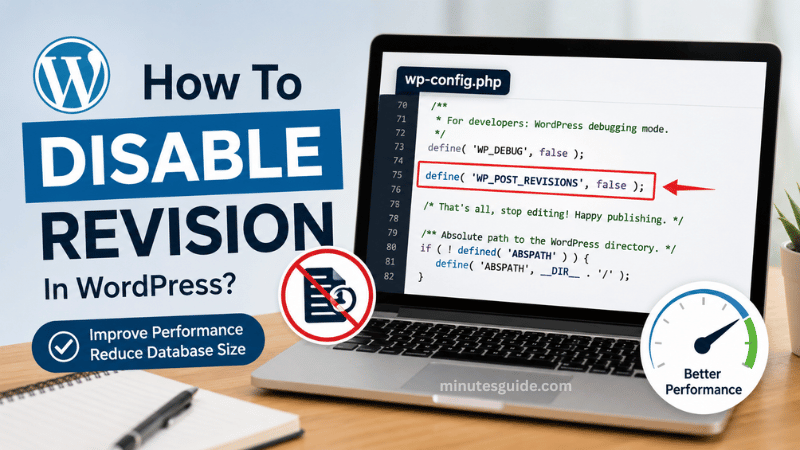
Disabling revisions is surprisingly simple. Since WordPress does not provide an option in the dashboard, you'll need to edit the wp-config.php file manually.
Always create a complete backup of your website before modifying any core configuration files.
Step 1: : Log in to Your cPanel
Log in to your hosting control panel using the credentials provided by your web hosting company.
Most shared hosting providers include cPanel, although some may use alternatives such as DirectAdmin or Plesk. The process remains similar regardless of the hosting platform.
Step 2: : Open File Manager
Inside cPanel, locate and open the File Manager.
Navigate to your WordPress installation directory. This is usually located inside:
public_htmlIf WordPress is installed inside a subfolder, navigate to that folder instead.
Step 3: : Locate wp-config.php
Find the file named:
wp-config.phpBefore editing, download a backup copy to your computer. This allows you to restore the original configuration if something goes wrong.
Step 4: : Edit the File
Open wp-config.php using the built-in code editor.
Add the following line before the line that says:
/* That's all, stop editing! Happy publishing. */Insert this code:
define('WP_POST_REVISIONS', false);Save the changes.
From this point onward, WordPress will stop creating new revisions for your posts and pages.
Existing revisions already stored in your database will remain there until they are manually deleted or removed using a database optimization plugin.
Alternative: Limit Revisions Instead of Disabling Them
Instead of completely turning off revisions, many website owners choose to limit the number of revisions WordPress keeps.
For example, if you only want WordPress to store the five most recent revisions, use:
define('WP_POST_REVISIONS', 5);If you prefer ten revisions:
define('WP_POST_REVISIONS', 10);This approach provides a good compromise because it reduces database growth while still allowing you to recover previous versions if necessary.
How To Delete Existing Revisions
Disabling revisions only affects future revisions. It does not remove revisions already stored in your database.
To clean existing revisions, you can use database optimization plugins such as:
- WP-Optimize
- Advanced Database Cleaner
- WP-Sweep
These plugins safely remove unnecessary revisions, drafts, spam comments, and other unused database records.
Always perform a full backup before cleaning your database.
Best Practices Before Disabling Revision
Before making this change, follow these recommendations:
Backup Your Website
Create a complete backup of both your files and database.
Test on a Staging Site
If your hosting provider offers a staging environment, test the configuration before applying it to your live website.
Keep Regular Backups
Without revisions, your backup system becomes even more important. Schedule automatic backups to ensure your content remains protected.
Monitor Website Performance
After disabling revisions, monitor your website's database size and overall performance to determine whether the change provides noticeable benefits.
Common Mistakes to Avoid
Many beginners accidentally make mistakes while editing the configuration file. Here are some common issues:
Editing the Wrong File
Only edit the wp-config.php file located in the root directory of your WordPress installation.
Placing the Code Incorrectly
The constant should be added before:
/* That's all, stop editing! Happy publishing. */Adding it elsewhere may prevent WordPress from recognizing the setting.
Forgetting Backups
Never modify WordPress configuration files without having a recent backup available.
Assuming Existing Revisions Will Disappear
Disabling revisions does not delete existing records. Separate database cleanup is required.
Conclusion
The WordPress Revision feature is designed to protect your content by automatically saving previous versions of your posts and pages. It is an excellent safety net that helps recover lost work and restore earlier drafts whenever necessary.
However, because revisions are stored indefinitely by default, they can gradually increase the size of your WordPress database. For websites with hundreds or thousands of articles, this can result in unnecessary database growth and increased maintenance requirements.
If you decide to disable revision, the process is straightforward and only requires adding a single line of code to your wp-config.php file. Before making this change, always create a complete backup of your website and carefully consider whether completely disabling revisions is the best option for your workflow.
For most website owners, limiting the number of revisions rather than disabling them entirely offers the ideal balance between maintaining a clean database and preserving the ability to recover valuable content when needed.
Frequently Asked Questions
Does disabling revisions delete my existing revisions?
No. Existing revisions remain inside your database until they are manually removed.
Can I enable revisions again later?
Yes. Simply remove or comment out the following line from your wp-config.php file:define('WP_POST_REVISIONS', false);
WordPress will immediately resume creating revisions.
Will autosave still work?
WordPress autosave behaves differently from revisions. Depending on your WordPress version and editor, autosave functionality may continue to work even when revisions are disabled.
Is disabling revisions recommended?
It depends on your workflow. Small personal blogs may benefit from disabling revisions, while business websites with multiple contributors usually benefit from keeping them enabled or limiting the number of stored revisions instead.
Will disabling revisions make WordPress faster?
It may improve database efficiency over time, especially on websites with extremely large databases. However, the performance improvement is usually modest and should not be expected to solve all website speed issues.
References
- How to Disable Page Revisions in WordPress? - stackoverflow.com
- How to disable and limit post revisions in WordPress - perfmatters.io