
If you have ever wondered about the difference between an alligator and a crocodile, you are certainly not alone. Many people use these names interchangeably because both reptiles share a similar appearance, belong to the same biological order, and live in warm climates. However, despite their similarities, these ancient predators have several important differences that distinguish them from one another.
Understanding the comparison between an Alligator vs Crocodile is not only useful for wildlife enthusiasts but also valuable for travelers, students, photographers, and anyone interested in nature. From their physical characteristics and habitats to their behavior, diet, and geographic distribution, these reptiles have evolved unique adaptations that help them survive in different environments.
This comprehensive guide explains everything you need to know about the differences between alligators and crocodiles. By the end of this article, you will be able to identify each species confidently and understand why they play such important roles in their ecosystems.
Table of Contents
Alligator vs Crocodile: What's the Difference?
What Are Alligators?
An alligator is a large semi-aquatic reptile belonging to the family Alligatoridae. There are only two living species of alligators in the world today.
- American Alligator (Alligator mississippiensis)
- Chinese Alligator (Alligator sinensis)
The American alligator is by far the most common species and is found throughout the southeastern United States. The Chinese alligator is much smaller and critically endangered, surviving in only a few protected areas in eastern China.
Alligators have existed for millions of years and are considered living fossils because their ancestors lived alongside dinosaurs. Although they have evolved over time, their body structure remains remarkably similar to prehistoric crocodilians.
What Are Crocodiles?
Crocodiles belong to the family Crocodylidae, which contains over a dozen species distributed across tropical and subtropical regions worldwide.
Some of the most well-known crocodile species include:
- Saltwater Crocodile
- Nile Crocodile
- American Crocodile
- Mugger Crocodile
- Siamese Crocodile
- Cuban Crocodile
Unlike alligators, crocodiles are found across Africa, Asia, Australia, North America, South America, and parts of Europe. They have adapted to survive in both freshwater and saltwater environments, making them one of the world's most successful apex predators.
Alligator vs Crocodile: Quick Comparison
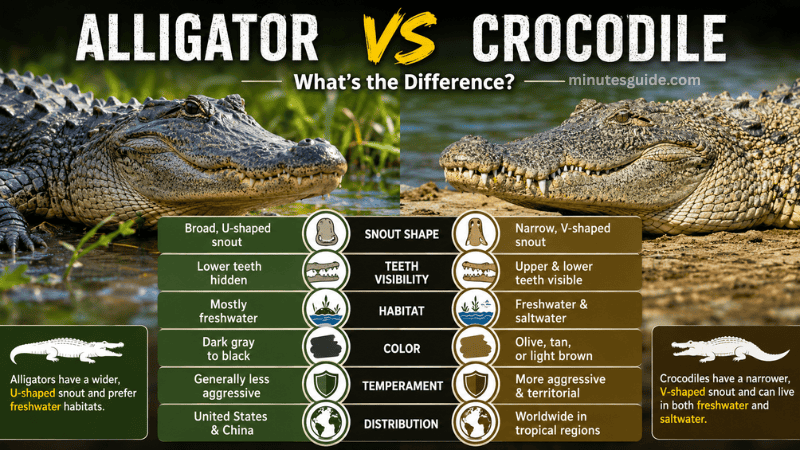
| Feature | Alligator | Crocodile |
|---|---|---|
| Snout Shape | Broad, U-shaped | Narrow, V-shaped |
| Teeth Visibility | Lower teeth hidden | Upper and lower teeth visible |
| Skin Color | Dark gray to black | Olive, tan, or light brown |
| Habitat | Mostly freshwater | Freshwater and saltwater |
| Salt Glands | Less effective | Highly developed |
| Temperament | Generally less aggressive | More aggressive |
| Distribution | United States and China | Worldwide in tropical regions |
| Maximum Size | Around 4.5 meters | Over 6 meters for some species |
| Bite Force | Extremely powerful | Extremely powerful |
Physical Differences Between Alligators and Crocodiles
Snout Shape
One of the easiest ways to distinguish an alligator from a crocodile is by examining its snout.
An alligator has a wide, rounded, U-shaped snout. This broader shape provides additional strength for crushing hard-shelled prey such as turtles, snails, and crustaceans.
A crocodile has a longer, narrower, V-shaped snout. This streamlined design is ideal for catching fish and other fast-moving prey in the water.
Simply observing the snout shape often provides the quickest identification method in the wild.
Teeth Visibility
Another reliable identifying feature is the way the teeth fit together when the mouth is closed.
When an alligator closes its mouth, only the upper teeth are normally visible. The lower teeth fit neatly into sockets in the upper jaw, creating a cleaner appearance.
In contrast, crocodiles display both upper and lower teeth even when their mouths are fully closed. One particularly noticeable feature is the large fourth tooth on the lower jaw, which remains exposed.
This visible tooth is one of the most recognizable characteristics of crocodiles.
Body Color
Although color alone should not be used for identification, it can provide useful clues.
Alligators generally appear darker, often displaying shades of black or dark gray. This coloration blends effectively into murky freshwater swamps and marshes.
Crocodiles are usually lighter in color, ranging from olive green and tan to light brown. Their coloration helps them camouflage in sandy riverbanks, estuaries, and coastal environments.
Body Build
Alligators tend to have broader bodies with slightly shorter snouts, giving them a more robust appearance.
Crocodiles generally possess leaner bodies, longer heads, and proportionally longer tails, making them particularly efficient swimmers over long distances.
Habitat Differences
Habitat is another major factor in the Alligator vs Crocodile comparison.
Where Do Alligators Live?
Alligators strongly prefer freshwater environments such as:
- Swamps
- Marshes
- Rivers
- Lakes
- Ponds
- Wetlands
Although they can tolerate small amounts of saltwater for short periods, they cannot survive permanently in highly saline environments because their salt glands are not very efficient.
Where Do Crocodiles Live?
Crocodiles are much more versatile.
They inhabit:
- Rivers
- Lakes
- Mangrove forests
- Estuaries
- Coastal lagoons
- Saltwater environments
Highly efficient salt glands located on their tongues allow crocodiles to remove excess salt from their bodies. This unique adaptation enables species such as the Saltwater Crocodile to thrive in oceans and travel between islands.
Geographic Distribution
The geographical range of these reptiles differs considerably.
Alligator Distribution
American alligators are found primarily in:
- Florida
- Louisiana
- Georgia
- Alabama
- Mississippi
- Texas
- South Carolina
- North Carolina
Chinese alligators survive only in a few protected regions of eastern China.
Crocodile Distribution
Crocodiles have a much wider global distribution, including:
- Africa
- Australia
- India
- Southeast Asia
- Central America
- South America
- Mexico
- Southern Florida
This broader distribution is one reason crocodiles are considered one of the most widespread reptile groups on Earth.
Size Comparison
When discussing Alligator vs Crocodile, size is another important distinction.
Average Alligator Size
Adult American alligators generally measure:
- Length: 3 to 4.5 meters
- Weight: 180 to 450 kilograms
Large males occasionally exceed these measurements but are relatively uncommon.
Average Crocodile Size
Depending on the species, crocodiles can become significantly larger.
For example:
- Nile Crocodile: up to 5.5 meters
- Saltwater Crocodile: over 6 meters
- Largest recorded specimens exceeded 7 meters
The Saltwater Crocodile is considered the largest living reptile on Earth.
Bite Force
Both reptiles possess some of the strongest bites ever measured in the animal kingdom.
Their bite strength allows them to:
- Crush turtle shells
- Capture large mammals
- Secure slippery fish
- Hold struggling prey underwater
Although crocodiles generally achieve slightly higher bite force measurements due to their larger size, both animals possess exceptionally powerful jaws capable of generating thousands of pounds of pressure.
Interestingly, the muscles used to open their mouths are relatively weak, which is why trained professionals can sometimes safely hold a crocodilian's jaws shut using specialized techniques. However, this should never be attempted by the general public.
Diet
Both alligators and crocodiles are carnivores.
Their diets change as they grow.
Young individuals consume:
- Insects
- Small fish
- Frogs
- Crustaceans
Adults eat:
- Fish
- Birds
- Snakes
- Turtles
- Mammals
- Deer
- Wild pigs
Large crocodile species are capable of hunting very large prey, including buffalo and antelope in certain parts of Africa and Australia.
Hunting Techniques
Both species are ambush predators.
Instead of chasing prey over long distances, they rely on patience, camouflage, and explosive speed.
A typical hunting strategy involves:
- Remaining almost completely submerged.
- Waiting silently near the shoreline.
- Detecting movement through highly sensitive pressure receptors.
- Launching an incredibly fast attack.
- Pulling prey underwater.
This strategy conserves energy while maximizing hunting success.
Behavior and Temperament
Behavior represents another important difference in the Alligator vs Crocodile comparison.
Alligator Behavior
Alligators are generally considered less aggressive toward humans.
Although attacks can occur, they usually happen when:
- The animal feels threatened.
- People feed wild alligators.
- Individuals approach nests.
- Pets enter the water.
Most alligators prefer avoiding human interaction whenever possible.
Crocodile Behavior
Many crocodile species are significantly more territorial and aggressive.
Species such as the Nile Crocodile and Saltwater Crocodile are responsible for more attacks on humans than alligator species.
These crocodiles often defend their territory aggressively and may attack boats, livestock, or people entering their habitat.
Swimming Ability
Both reptiles are exceptional swimmers.
Their muscular tails provide tremendous propulsion through the water.
While swimming, they keep most of their bodies submerged, exposing only their eyes and nostrils above the surface.
This stealthy posture allows them to approach prey almost unnoticed.
Reproduction
Female alligators and crocodiles build nests using vegetation, mud, or sand.
After laying eggs, the mother guards the nest carefully throughout incubation.
Once the eggs begin to hatch, the babies make chirping sounds from inside the shells.
The mother gently digs open the nest and may even carry the hatchlings in her mouth to nearby water.
Despite their fearsome appearance, both species exhibit surprisingly attentive parental care during the early stages of life.
Lifespan
Both reptiles are remarkably long-lived.
Average lifespan:
| Species | Average Lifespan |
|---|---|
| American Alligator | 35–50 years in the wild |
| Saltwater Crocodile | 60–70 years or more |
| Nile Crocodile | 50–70 years |
| Chinese Alligator | Around 50 years |
Some captive individuals have lived considerably longer under professional care.
Conservation Status
Conservation efforts have produced mixed results.
The American alligator is considered one of the greatest wildlife conservation success stories after recovering from severe population declines caused by hunting and habitat destruction.
However, several crocodile species remain threatened due to:
- Habitat loss
- Illegal hunting
- Pollution
- Human conflict
- Climate change
Protecting wetlands remains essential for ensuring the survival of these ancient reptiles.
Interesting Facts
- Crocodilians first appeared over 80 million years ago.
- They can replace lost teeth many times throughout their lives.
- Their eyes, ears, and nostrils sit on top of their heads, allowing them to remain almost completely submerged while observing their surroundings.
- They possess excellent night vision.
- Their skin contains sensory organs capable of detecting tiny water vibrations.
- Baby crocodilians communicate with their mothers before hatching.
- They play an important ecological role by maintaining healthy aquatic ecosystems.
Which Is More Dangerous?
When comparing Alligator vs Crocodile, crocodiles are generally considered more dangerous.
Several reasons contribute to this reputation:
- Larger average body size.
- More aggressive territorial behavior.
- Greater tendency to inhabit areas frequented by humans.
- More documented attacks worldwide.
Nevertheless, both animals deserve respect. They are powerful wild predators that should always be observed from a safe distance.
How to Identify an Alligator or Crocodile Quickly
If you need a quick way to tell them apart, remember these simple clues:
- U-shaped snout = Alligator
- V-shaped snout = Crocodile
- Hidden lower teeth = Alligator
- Visible lower teeth = Crocodile
- Dark body = Alligator
- Lighter olive body = Crocodile
- Freshwater preference = Alligator
- Saltwater tolerance = Crocodile
These characteristics allow even beginners to identify most species accurately.
Conclusion
The comparison between an Alligator vs Crocodile reveals that these remarkable reptiles share a common ancestry yet have evolved distinct characteristics that suit different environments. Although both belong to the order Crocodylia and possess powerful jaws, armored bodies, and exceptional hunting abilities, they differ in snout shape, teeth visibility, coloration, habitat preferences, geographic distribution, behavior, and saltwater adaptation.
Alligators are generally darker in color, feature broad U-shaped snouts, and primarily inhabit freshwater wetlands in the United States and China. Crocodiles, by contrast, have narrower V-shaped snouts, lighter coloration, and highly efficient salt glands that allow many species to thrive in both freshwater and marine environments across tropical regions worldwide.
Understanding these differences not only helps identify these fascinating reptiles more accurately but also highlights the importance of conserving their habitats. As apex predators, both alligators and crocodiles contribute significantly to maintaining healthy ecosystems, making their protection essential for preserving biodiversity for future generations.
Frequently Asked Questions (FAQs)
What is the main difference between an alligator and a crocodile?
The main difference between an alligator and a crocodile lies in their snout shape, teeth, habitat, and behavior. Alligators have broad, U-shaped snouts and typically hide their lower teeth when their mouths are closed. Crocodiles have narrower, V-shaped snouts, and both their upper and lower teeth remain visible even when the mouth is shut. Crocodiles are also generally more tolerant of saltwater and are considered more aggressive than alligators.
Which is more dangerous, an alligator or a crocodile?
Crocodiles are generally considered more dangerous because many species are larger, more territorial, and more aggressive toward humans. Species such as the Saltwater Crocodile and Nile Crocodile are responsible for a higher number of attacks worldwide. While alligators can also be dangerous, they are usually less aggressive and tend to avoid human contact whenever possible.
Can alligators and crocodiles live in the same habitat?
Yes, some species can share the same habitat. For example, the American Alligator and the American Crocodile both live in southern Florida. However, they often occupy slightly different environments. Alligators usually prefer freshwater habitats, while crocodiles are more likely to inhabit brackish or saltwater areas.
Why can crocodiles live in saltwater but alligators cannot?
Crocodiles possess highly efficient salt glands located on their tongues that help remove excess salt from their bodies. This adaptation allows them to survive in marine environments and travel across coastal waters. Alligators also have salt glands, but they are much less effective, limiting them mainly to freshwater habitats.
Which is bigger, an alligator or a crocodile?
On average, crocodiles grow larger than alligators. Adult American alligators typically reach lengths of 3 to 4.5 meters, while large crocodile species, such as the Saltwater Crocodile, can exceed 6 meters in length and weigh more than 1,000 kilograms.
How can you quickly tell the difference between an alligator and a crocodile?
The easiest way to identify them is by looking at the snout and teeth. A broad, U-shaped snout with hidden lower teeth usually indicates an alligator. A narrow, V-shaped snout with visible upper and lower teeth indicates a crocodile. Body color can also help, as alligators are generally darker, while crocodiles tend to be lighter olive or tan.
Do alligators and crocodiles eat the same food?
Both are carnivorous predators with similar diets that include fish, birds, reptiles, amphibians, and mammals. However, larger crocodile species are capable of hunting much bigger prey, including deer, buffalo, and antelope, depending on their habitat.
Where are alligators found?
American alligators are found primarily in the southeastern United States, including Florida, Louisiana, Georgia, Alabama, Mississippi, and Texas. The Chinese alligator is native to eastern China, where it survives only in a few protected areas due to its critically endangered status.
Where are crocodiles found?
Crocodiles have a much wider distribution than alligators. They can be found throughout Africa, Asia, Australia, Central America, South America, parts of North America, and some regions of Europe. Many species inhabit both freshwater rivers and coastal marine environments.
Are alligators and crocodiles dinosaurs?
No. Alligators and crocodiles are not dinosaurs, but they are close evolutionary relatives of birds and belong to an ancient group of reptiles known as crocodilians. Their ancestors lived during the age of dinosaurs, making them one of the oldest surviving reptile groups on Earth.
How long do alligators and crocodiles live?
Most alligators live between 35 and 50 years in the wild, although some individuals can live much longer in captivity. Many crocodile species have lifespans of 60 to 70 years or more, with some exceptionally long-lived individuals exceeding these averages under professional care.
Why are alligators and crocodiles important to the ecosystem?
Alligators and crocodiles are apex predators that help maintain healthy ecosystems by regulating prey populations and supporting biodiversity. Their nesting activities, burrows, and movement through wetlands also create habitats that benefit many other plant and animal species.
References
- Alligator vs. Crocodile: What's the Difference? - pbs.org
- What's the Difference Between an Alligator and a Crocodile? - animals.howstuffworks.com