
Configuring the WordPress General Settings – Complete Guide | WordPress is one of the most widely used content management systems for creating blogs, business websites, online portfolios, membership platforms, and e-commerce stores. Although WordPress provides a user-friendly dashboard, configuring its settings correctly is an important step towards building a professional, secure, and well-organised website. One of the first areas every website owner should understand is the WordPress General Settings page.
The WordPress General Settings section allows administrators to configure essential website information, including the site title, tagline, WordPress Address (URL), Site Address (URL), administration email address, membership registration options, website language, timezone, date format, and time format. These settings influence how WordPress identifies the website, how certain administrative functions operate, and how dates and times appear throughout the website.
Whether you are creating a new WordPress website or managing an established blog, understanding how to configure WordPress General Settings can help you avoid common configuration mistakes. Incorrect settings, particularly those involving website URLs, can affect website accessibility and make it difficult to access the administration dashboard.
In this complete guide, you will learn how to access the WordPress General Settings page, understand the purpose of each available option, configure the settings correctly, and troubleshoot common problems that may occur after making changes.
Table of Contents
Configuring the WordPress General Settings – Complete Guide
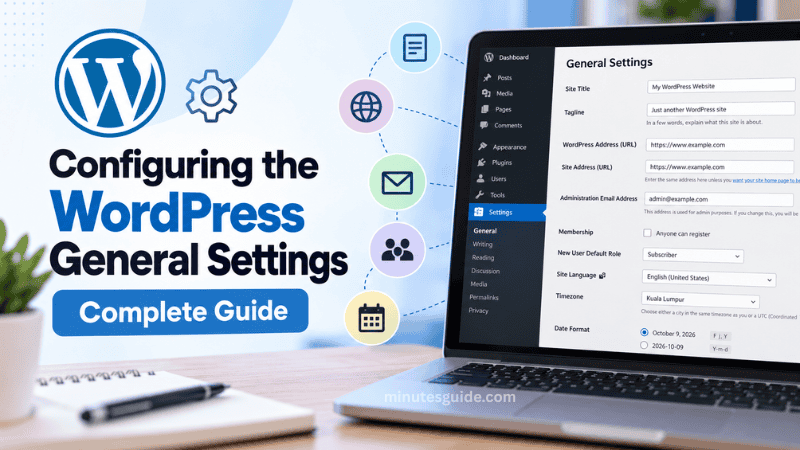
What Are WordPress General Settings?
WordPress General Settings are a collection of basic configuration options that control the fundamental information and regional preferences of a WordPress website. These options are available through the WordPress administration dashboard and are usually among the first settings that website owners configure after installing WordPress.
The General Settings page provides a central location for managing important website details without requiring users to edit PHP files or modify the WordPress database manually. Most options can be changed through a simple interface, making this section suitable for beginners as well as experienced website administrators.
For example, you can use General Settings to change your website's name, provide a short description of its purpose, select the language used by the WordPress administration interface, and configure the timezone used for publishing schedules. You can also determine whether visitors are allowed to register accounts on your website.
It is important to understand that WordPress General Settings do not control every aspect of a website. More advanced configurations, such as permalink structures, reading preferences, discussion settings, media settings, and user roles, are managed through other sections of the WordPress dashboard.
Nevertheless, configuring the WordPress General Settings correctly provides a reliable foundation for managing your website and ensuring that its basic information is accurate.
How to Access WordPress General Settings
Accessing the WordPress General Settings page is straightforward, provided that you have administrator access to your WordPress dashboard.
Follow these steps to open the settings page:
- Log in to your WordPress administration dashboard by visiting
https://yourdomain.com/wp-admin/, replacingyourdomain.comwith your actual domain name. - Enter your WordPress username and password to authenticate your account.
- Locate the Settings menu in the left-hand navigation panel.
- Click Settings to expand the available configuration options.
- Select General to open the WordPress General Settings page.
- Review the existing configuration before making any changes.
- Update the relevant fields according to your website's requirements.
- Click Save Changes at the bottom of the page to apply your modifications.
After saving the changes, WordPress will display a confirmation message indicating that the settings have been updated successfully.
Keep in mind that the exact appearance of the dashboard may differ depending on your WordPress version, installed plugins, user permissions, and administrative interface customisations. If you cannot see the General Settings option, verify that you are logged in with an account that has sufficient permissions to manage website settings.
Understanding the WordPress General Settings Options
The WordPress General Settings page contains several fields, and each one serves a different purpose. Understanding these options will help you configure your website appropriately and reduce the risk of making changes that affect its operation.
1. Site Title
The Site Title field defines the name of your WordPress website. This name identifies your website and may appear in browser tabs, website headers, search engine listings, and other locations, depending on your active WordPress theme and SEO configuration.
For example, if you operate a website about WordPress tutorials, you might use a site title such as "WordPress Tutorial Guide". If your website focuses on technology news, a title such as "Tech Insights" may communicate its subject more clearly.
When choosing a site title, select a name that accurately represents your website's identity, subject matter, or business. A clear and memorable title helps visitors recognise your website and understand what it offers.
It is also advisable to maintain consistency between your site title, branding, logo, and other website materials. If you have already established a recognised brand, changing the site title unnecessarily may create confusion for returning visitors.
However, changing the Site Title field does not automatically guarantee that search engines will display the new title immediately. Search engines determine how to present search results using multiple signals, and an SEO plugin or theme may also provide separate title settings for individual pages.
2. Tagline
The Tagline field allows you to provide a short description of your website. It is intended to communicate the website's primary purpose, subject, or value in a concise statement.
For example, a website about WordPress might use the tagline "Practical WordPress Tutorials for Beginners". A business website could use "Professional Website Design and Digital Solutions", while a food blog might use "Recipes, Cooking Tips, and Kitchen Guides".
A useful tagline should be clear, relevant, and easy to understand. Avoid writing a lengthy paragraph because the purpose of this field is to summarise your website rather than explain every service or topic it covers.
Depending on the theme and website configuration, the tagline may appear beneath the site title in the header or in other parts of the website. Some themes do not display the tagline by default, even when a value has been entered.
The tagline may also be used as a source of information by certain themes and plugins. However, it should not be confused with the meta description of an individual page, which is normally managed through an SEO plugin or another relevant tool.
If you are creating a new website, write a meaningful tagline that reflects its purpose. If you prefer not to display a tagline, you can leave the field empty when appropriate.
3. WordPress Address (URL)
The WordPress Address (URL) field specifies the location where the core WordPress application files are installed. These files include the software responsible for running the WordPress dashboard, processing website requests, and providing the platform's fundamental functionality.
For many websites, the WordPress Address is the same as the main website address. For example:
However, some websites install WordPress in a separate directory. In such cases, the WordPress Address might look like this:
The correct value depends on how WordPress was installed and configured on your hosting account. You should not change this field simply because you prefer a different-looking URL.
Using HTTPS is generally recommended because it encrypts connections between visitors and your website when a valid SSL/TLS certificate is configured. Nevertheless, the WordPress Address must match the actual environment in which your WordPress installation operates.
Changing this field incorrectly can prevent WordPress from loading properly, break access to the administration dashboard, or cause website resources to load from an incorrect location. In some situations, you may need to correct the value through your hosting control panel, configuration file, or database.
Before modifying the WordPress Address, confirm your existing installation directory and ensure that your hosting environment supports the intended URL.
4. Site Address (URL)
The Site Address (URL) field defines the public-facing address visitors use to access your WordPress website. It determines the base URL that WordPress uses when presenting the website to visitors.
On a typical WordPress installation, the Site Address is identical to the WordPress Address. For example, both fields might contain:
However, there are situations in which these addresses differ. One example is a website where WordPress is installed in a subdirectory while the public-facing website is accessed through the root domain.
For example, WordPress might be installed at:
Meanwhile, visitors might access the website through:
This type of configuration requires the appropriate installation and server setup. It should not be attempted simply by changing the Site Address field without preparing the rest of the environment.
The WordPress Address and Site Address have different purposes, even though they are often identical. The first identifies the location of the WordPress application, while the second identifies the public address of the website.
If you want to move your website from HTTP to HTTPS, change its domain, or modify its directory structure, plan the migration carefully. You may need to update redirects, database references, SSL/TLS configuration, and other website settings to prevent broken links and accessibility problems.
5. Administration Email Address
The Administration Email Address field contains the email address WordPress uses for important administrative communications. Depending on your WordPress version and configuration, these communications may include notifications related to website administration and certain account or system events.
For example, you could use an address such as admin@example.com or website@example.com if you control the relevant mailbox and it is suitable for administrative notifications.
It is important to use an email address that you can access reliably. If WordPress needs to send an administrative notification, an incorrect or inaccessible address may prevent you from receiving information that requires your attention.
When you change the administration email address, WordPress may require you to confirm the new address before the change takes effect. Follow any confirmation instructions displayed on the dashboard.
Do not assume that this field automatically changes the email address associated with every WordPress user account. Individual user profiles may have their own email addresses, and plugins may use separate settings for contact forms, marketing messages, transactional emails, or order notifications.
For a business website, consider using a dedicated mailbox that is monitored regularly rather than relying exclusively on a personal email account. This can make administrative communication easier to manage, particularly when several people are involved in maintaining the website.
You should also test your website's email delivery configuration if important messages are not arriving. Depending on your hosting environment, an SMTP plugin or an external email delivery service may be necessary to improve reliability.
6. Membership
The Membership setting determines whether visitors are allowed to register new accounts through the standard WordPress registration functionality.
The option is usually presented as a checkbox labelled "Anyone can register". When this option is enabled, visitors may be able to create accounts through the registration interface, depending on your other settings and any restrictions imposed by your theme, plugins, or security configuration.
For a typical business website or personal blog, leaving this option disabled is often appropriate because most visitors do not need their own WordPress accounts.
However, enabling registration may be necessary if you operate a membership website, community platform, educational portal, or other service that requires users to create accounts.
Before enabling this option, consider the potential security and administrative implications. Public registration can attract spam accounts, automated sign-ups, and other unwanted activity if the website does not have suitable protections.
If you decide to allow registration, consider implementing appropriate safeguards, such as email verification, CAPTCHA or other anti-bot measures, registration restrictions, and regular account monitoring. The most suitable approach depends on the functionality and risk profile of your website.
Remember that enabling registration does not automatically create a complete membership system. Additional functionality, such as paid subscriptions, restricted content, user dashboards, and recurring payments, may require dedicated plugins or custom development.
7. New User Default Role
The New User Default Role setting determines the WordPress role assigned to users who register through the standard registration process.
WordPress includes several default roles, and each role has a different set of permissions.
| User role | General purpose |
|---|---|
| Subscriber | Primarily intended for users who need to manage their own profile and access permitted content. |
| Contributor | Can write and manage their own posts but cannot publish them directly under the standard permissions. |
| Author | Can write, manage, and publish their own posts. |
| Editor | Can manage and publish posts, including content created by other users, subject to the role's permissions. |
| Administrator | Has broad control over website settings, users, content, and other administrative functions. |
For websites that allow public registration, Subscriber is generally a sensible default when users only need basic accounts.
Assigning Administrator as the default role is strongly discouraged for public registration because it could grant newly registered users extensive control over the website. An unauthorised administrator could modify settings, install or remove plugins, change content, or interfere with other users.
You should also understand that the New User Default Role setting does not automatically determine the permissions of existing users. Existing accounts retain their assigned roles unless those roles are changed separately.
If your website does not permit public registration, this setting is less relevant to ordinary visitors. Nevertheless, reviewing it is worthwhile because it helps ensure that any future registration functionality follows the principle of least privilege.
8. Site Language
The Site Language setting determines the language used by the WordPress administration interface and, where available, the language of WordPress core translations.
WordPress supports many languages, allowing website administrators to work in a language they understand comfortably. Depending on the language selected and the translations available, WordPress may download or use the corresponding language files.
For example, a website administrator who prefers English can select an English language option. An administrator managing a Malaysian website may choose an appropriate Malay language option if it is available in the installation.
It is important to distinguish the administration interface language from the language of your website's content. Changing the Site Language does not automatically translate existing articles, product descriptions, menus, or other text written by you.
Likewise, the language of the dashboard does not necessarily determine the language of every theme or plugin. Translation availability depends on the software installed and the language files provided by its developers.
When choosing a language, consider the people who manage the website and the language in which they prefer to work. If several administrators maintain the same website, remember that WordPress can also support individual language preferences through user profile settings, depending on the available configuration.
Selecting the appropriate language can make routine website management more convenient and reduce misunderstandings when configuring WordPress.
9. Timezone
The Timezone setting determines the local time WordPress uses for functions such as scheduled publishing and the display of dates and times generated by WordPress.
Choosing the correct timezone is particularly important if you publish articles according to a schedule, manage events, or maintain a website that serves an audience in a specific region.
For example, a website targeting readers in Malaysia would generally use the Kuala Lumpur timezone, which corresponds to Malaysia Time (MYT), or UTC+08:00. This helps align scheduled publication times with the local time expected by the website administrator and audience.
When configuring the timezone, select the appropriate city or regional timezone if it is available. City-based timezone identifiers can account for daylight-saving changes in regions that observe them, whereas a fixed UTC offset does not automatically adjust for seasonal clock changes.
Malaysia does not currently observe daylight saving time, so its standard time remains UTC+08:00 throughout the year.
An incorrect timezone can cause scheduled posts to appear earlier or later than expected. It can also affect timestamps displayed by certain plugins, event calendars, and other WordPress features that rely on the configured timezone.
If you publish content regularly, check the timezone before scheduling your first article. You should also review the setting after migrating a website to another server or changing the location from which the website is managed.
10. Date Format
The Date Format setting determines how WordPress displays dates in locations that use the platform's standard date-formatting functions.
Different countries and audiences use different date conventions. For example, a date may be displayed as month/day/year or day/month/year, depending on the format selected.
WordPress typically provides several preset formats, such as:
| Date format | Example |
|---|---|
| F j, Y | October 9, 2026 |
| Y-m-d | 2026-10-09 |
| m/d/Y | 10/09/2026 |
| d/m/Y | 09/10/2026 |
| d-m-Y | 09-10-2026 |
These examples demonstrate how the same date can appear in different formats. When selecting a format, consider which convention your readers are most familiar with and whether your website publishes content for an international audience.
For many Malaysian websites, a day/month/year format is familiar and may be more suitable than a month/day/year format. However, the best choice depends on your audience and the nature of your content.
If none of the preset options meets your requirements, WordPress may allow you to enter a custom date format using PHP date-format characters.
For example, d F Y displays a date such as "09 October 2026", while j M Y displays it as "9 Oct 2026".
Keep in mind that changing the general date format does not guarantee that every plugin, theme, or custom template will follow the same format. Some components provide their own date-format settings, while others display dates using custom code.
11. Time Format
The Time Format setting determines how WordPress displays times in areas that use the platform's standard time-formatting functions.
WordPress generally provides both 12-hour and 24-hour time formats. The 12-hour format uses AM and PM indicators, while the 24-hour format represents the time using values from 00:00 to 23:59.
Examples include:
wordpress-time-format.csv
| Time format | Example |
|---|---|
| g:i a | 9:30 am |
| g:i A | 9:30 AM |
| H:i | 09:30 |
| G:i | 9:30 |
The choice between these formats is largely a matter of preference and audience expectations.
A Malaysian website may use the 24-hour format because it is common in many official, business, and administrative contexts. However, a lifestyle blog targeting an international audience may prefer a 12-hour format if it better matches its editorial style.
As with date formatting, some themes and plugins may have independent time-display options. If a particular section of your website continues to display times differently after you change the General Settings, check whether that component provides its own configuration.
12. Week Starts On
The Week Starts On setting determines which day WordPress treats as the first day of the week in features that rely on this preference.
For example, you can select Monday if your website follows a Monday-to-Sunday calendar. Alternatively, you can select Sunday if that convention is more suitable for your audience.
This setting is particularly relevant to calendar-related functionality and plugins that use WordPress's configured start of the week. It may have little or no visible effect on a simple blog that does not use calendar features.
When choosing the first day of the week, consider your audience's regional conventions and the way your website presents schedules, events, or other date-related information.
If your website serves a Malaysian audience, Monday may be a practical choice for business-oriented calendars and work schedules. Nevertheless, you should select the option that best fits your actual requirements rather than assuming that every website must use the same setting.
After selecting your preferred day, save the changes and review any relevant calendar or scheduling features to confirm that they display the week as expected.
Recommended WordPress General Settings for a New Website
If you are setting up a new WordPress website, it can be helpful to follow a consistent configuration approach. The recommended values below provide a general starting point for a typical blog or business website.
Your exact settings should depend on the website's purpose, intended audience, installation structure, and administrative requirements.
| Setting | Recommended configuration | Reason |
|---|---|---|
| Site Title | Your website or business name | Establishes the website's identity. |
| Tagline | A short, accurate description | Explains the website's purpose. |
| WordPress Address | The actual WordPress installation URL | Ensures WordPress can locate its core application. |
| Site Address | The correct public-facing website URL | Allows visitors to access the intended website address. |
| Administration Email Address | An accessible administrative mailbox | Helps ensure that important notifications can be received. |
| Membership | Disabled for most standard blogs and business websites | Reduces unnecessary public registration. |
| New User Default Role | Subscriber, when public registration is required | Limits the permissions assigned to new users. |
| Site Language | The preferred language of the administrators | Makes the dashboard easier to manage. |
| Timezone | The timezone appropriate for the website | Helps ensure that scheduled posts use the expected local time. |
| Date Format | A format familiar to the target audience | Improves consistency and readability. |
| Time Format | A format suitable for the audience | Makes displayed times easier to understand. |
| Week Starts On | Monday or another appropriate day | Aligns calendar displays with the intended convention. |
These recommendations are not universal rules. For example, a membership platform may need public registration, while a website with an existing WordPress installation in a subdirectory may require different URL values.
The most important principle is to configure each setting according to your website's actual requirements rather than copying settings from another website without understanding their purpose.
How to Configure WordPress General Settings for SEO
Correctly configuring WordPress General Settings can support a more consistent website experience, although these settings alone cannot guarantee higher search engine rankings.
Several fields are particularly relevant to website identity, technical consistency, and the presentation of information.
Choose an Appropriate Site Title
Your Site Title should accurately represent your website or brand. A descriptive title helps users recognise your website when they encounter it through links, browser tabs, or other interfaces that display the site name.
If your website focuses on a specific subject, you may include a relevant descriptive phrase when it fits naturally. However, avoid filling the title with repetitive keywords or making it unnecessarily long.
For example, a website called "Minutes Guide" could use a tagline describing its tutorials and practical guides rather than turning the Site Title into a long list of unrelated search terms.
The site title should communicate the website's identity clearly while remaining consistent with its branding.
Write a Meaningful Tagline
A useful tagline explains what readers can expect from your website. It should describe the site's subject or value in straightforward language rather than relying on exaggerated claims or a collection of keywords.
For example, a WordPress tutorial website could use "Step-by-Step Guides for WordPress Users". This tells visitors what the website offers without requiring a lengthy explanation.
Although themes and plugins may use the tagline in different ways, you should not assume that entering a tagline automatically creates a search engine meta description. If you want to configure meta descriptions for individual pages or posts, use the relevant settings in your SEO plugin or theme.
Use Consistent Website URLs
The WordPress Address and Site Address should reflect the actual configuration of your website. Inconsistent URL settings can create technical problems, particularly when switching between HTTP and HTTPS or changing the preferred domain format.
For example, if your website uses https://www.example.com, ensure that its configuration, redirects, canonical URLs, and internal links are consistent with that arrangement.
Whether you use the www or non-www version is generally a matter of preference and technical configuration. What matters is choosing the intended public address and ensuring that alternative versions are handled correctly.
Do not change URL settings solely for SEO purposes without understanding the technical consequences. If you are changing domains or moving your website to HTTPS, prepare a migration plan and verify that the necessary redirects and references are updated.
Set the Correct Timezone
An accurate timezone is useful when publishing content according to a schedule. If your website is configured to use a timezone that differs significantly from your local time, scheduled posts may not appear at the intended time.
For example, a Malaysian blogger who intends to publish an article at 9:00 AM Malaysia Time should ensure that WordPress uses the correct timezone before scheduling the article.
A consistent publishing schedule can support an organised editorial workflow. However, the timezone itself is not a direct ranking factor, and changing it does not automatically improve SEO performance.
Keep Your Website Information Accurate
Review your site title, tagline, and other basic information whenever your website undergoes a significant change, such as a rebranding, a change in business focus, or a major redesign.
Accurate information helps maintain consistency between your website's identity and the experience visitors receive. It also makes website administration easier because the settings reflect the website's current purpose.
Avoid making unnecessary changes simply to experiment with different keyword combinations. Instead, prioritise clarity, accuracy, and consistency.
Common Mistakes When Configuring WordPress General Settings
Although the General Settings page is relatively straightforward, certain mistakes can cause technical problems or create an inconsistent website experience.
Understanding these issues before changing your configuration can help you avoid unnecessary downtime and administrative difficulties.
Changing the WordPress Address Without Preparation
One of the most serious mistakes is changing the WordPress Address without confirming that the WordPress installation is available at the new location.
If the value no longer matches the actual installation, WordPress may attempt to load resources or redirect requests to an incorrect URL. This can make the website or administration dashboard inaccessible.
Before changing this field, confirm your installation structure and ensure that you have a reliable recovery method. If you are migrating the website, prepare the server configuration and database changes required by the new arrangement.
Using an Incorrect Site Address
An incorrect Site Address can prevent visitors from reaching the intended public-facing website. It may also affect internal links, redirects, and other URL-dependent functions.
For example, entering a URL that includes an unnecessary directory or an incorrect domain may cause WordPress to direct visitors to the wrong location.
Always verify the public-facing URL before saving changes, particularly when you are managing an established website.
Leaving the Administration Email Address Outdated
An outdated administration email address can prevent important messages from reaching the person responsible for managing the website.
If you change your email provider or stop using a particular mailbox, update the administration email address and complete any required confirmation process.
It is also worth testing whether your website can send emails successfully. A correctly configured address does not guarantee delivery if the hosting environment has email restrictions or messages are rejected by the recipient's mail server.
Allowing Unrestricted User Registration
Enabling public registration without a clear business requirement can create additional security and moderation responsibilities.
Spam registrations may increase the number of accounts that need to be reviewed, while poorly configured user roles may give new accounts more permissions than necessary.
If your website needs public registration, use a suitable default role and implement appropriate controls. If visitors do not need accounts, leaving registration disabled is usually the simpler approach.
Selecting the Wrong Timezone
An incorrect timezone can cause scheduled posts to be published at unexpected times. This may be particularly inconvenient for bloggers who maintain an editorial calendar or businesses that publish time-sensitive announcements.
Check the timezone before scheduling content and verify that it matches the intended region.
If you change the timezone on an established website, review upcoming scheduled posts to ensure that their publication times still match your expectations.
Assuming Every Plugin Uses the General Settings
Not every plugin or theme follows the global settings for every feature. A calendar plugin, booking system, membership platform, or custom theme may have separate controls for dates, times, registration, or email delivery.
If a component behaves differently from what you expect, review its documentation and settings before changing the WordPress General Settings unnecessarily.
This approach helps you identify the actual source of the problem and reduces the risk of disrupting unrelated website functionality.
Troubleshooting WordPress General Settings Problems
If a problem occurs after you update the WordPress General Settings, the appropriate solution depends on which setting was changed and how the website is configured.
Unable to Access the WordPress Dashboard After Changing the URL
If the WordPress dashboard becomes inaccessible after changing the WordPress Address or Site Address, first determine whether the website is redirecting to an incorrect domain or directory.
If you have access to your hosting account, you may be able to recover the website by correcting the URL configuration through the appropriate method.
Possible recovery methods include:
- Restoring the previous URL values through a suitable database administration tool.
- Using the WordPress configuration file to define the correct URL values, when appropriate.
- Restoring a recent backup if the change caused additional problems.
- Contacting your hosting provider for assistance if you cannot safely access the relevant configuration.
For example, WordPress supports defining WP_HOME and WP_SITEURL in the wp-config.php file to override the corresponding database values. These constants must be set carefully, using the correct URLs for your installation.
Before editing configuration files or the database, create a backup whenever possible. If you are unfamiliar with these procedures, ask your hosting provider or a qualified WordPress developer to help you recover access.
Scheduled Posts Are Published at the Wrong Time
If scheduled posts appear earlier or later than expected, check the timezone under Settings > General.
Confirm that the selected timezone matches the region you intend to use. For Malaysia, the relevant timezone is Kuala Lumpur, which uses UTC+08:00 throughout the year.
Next, review the publication times of scheduled posts and check whether any relevant plugin has a separate timezone configuration.
If the problem continues, investigate other possible causes, such as custom scheduling code or plugin-specific behaviour, rather than assuming that the General Settings page is responsible for every scheduling issue.
The Website Displays the Wrong Site Title or Tagline
If your website continues to display an old site title or tagline after you save the changes, first confirm that the new values appear correctly under Settings > General.
Next, check your active theme's customisation settings and any page-building tools that control the website header. Some themes display a custom logo or manually configured site identity rather than the values you expect to see.
If the old information still appears after you have verified the configuration, clear the relevant website cache and browser cache, where appropriate. Search engine listings may also take time to reflect changes because search engines control when they recrawl and update their results.
The Administration Email Address Is Not Receiving Messages
If important administrative messages are not arriving, confirm that the email address is correct and that any pending verification has been completed.
Then check the mailbox's spam folder and verify that the mailbox can receive messages. If the issue continues, investigate the website's email delivery configuration.
Depending on the hosting environment, configuring SMTP or using a reliable email delivery service may help resolve problems with WordPress-generated emails.
Remember that changing the administration email address does not automatically fix a separate email delivery problem. Both the destination address and the system responsible for sending messages must be configured correctly.
Changes Are Not Appearing on the Website
If you save the General Settings but cannot see the expected changes, confirm that WordPress displayed a successful update message.
Next, clear the appropriate caches if your website uses a caching plugin, hosting-level cache, content delivery network, or browser cache. Be aware that caching is not necessarily the cause of every problem, so inspect the actual configuration if the changes remain unavailable.
You should also check whether your theme or plugins use separate settings that override or replace the information displayed on the website.
Best Practices for Managing WordPress General Settings
Maintaining accurate WordPress General Settings is an ongoing administrative responsibility, even though most websites do not need to change these options frequently.
The following practices can help you manage your website more safely and consistently.
Review the Settings After Installation
When you first install WordPress, review every field under Settings > General before publishing content.
Confirm that the site title, tagline, website URLs, administration email address, language, timezone, and date and time formats match your requirements.
If the website will allow account registration, review the Membership and New User Default Role settings as well.
Completing this review early reduces the likelihood of discovering an important configuration problem after your website has already attracted visitors.
Back Up Your Website Before Making Risky Changes
Most General Settings changes are straightforward, but modifying the WordPress Address or Site Address can affect access to the website.
Before making URL-related changes on an established website, create a current backup of the database and website files. Confirm that the backup can be restored if necessary.
A backup is particularly important when making changes as part of a domain migration, directory relocation, hosting migration, or HTTPS implementation.
Use Secure Website URLs
Whenever your hosting environment is correctly configured for HTTPS, use the appropriate secure website URLs.
Confirm that your SSL/TLS certificate is valid and that the website's redirects and internal references are configured consistently. If you are migrating an existing website from HTTP to HTTPS, plan the migration rather than changing the General Settings fields in isolation.
You should also verify that important pages, images, stylesheets, scripts, and other resources load correctly after the change.
Apply the Principle of Least Privilege
If your website allows users to register, assign the lowest permission level that meets their actual needs.
For most public registration systems, Subscriber is a reasonable starting point because it does not provide the extensive administrative privileges associated with higher-level roles.
Only grant additional permissions when they are necessary for a user's responsibilities. Review existing user accounts periodically to ensure that their roles remain appropriate.
Document Important Configuration Changes
If you manage a business website or work with a team, keep a record of significant configuration changes, particularly those involving URLs, registration, and administrative contact details.
Documenting changes makes it easier to investigate problems and understand why the website behaves differently after an update.
For websites managed by multiple people, this practice can also reduce the risk of one administrator accidentally reversing another administrator's configuration.
Review Settings After Website Migration
A website migration can introduce differences in domain names, directory structures, server configuration, and email delivery.
After moving your website to another hosting provider or domain, review the General Settings to confirm that the WordPress Address and Site Address are correct. Check the administration email address, timezone, language, and other relevant options as well.
You should also test the website's navigation, scheduled posts, administrative access, and email delivery to ensure that the migration has not affected important functionality.
Conclusion
Configuring the WordPress General Settings correctly is an essential step in establishing and maintaining a reliable WordPress website. Although this section contains relatively simple options, each setting contributes to the website's identity, administrative communication, user registration, regional preferences, or technical configuration.
By understanding the purpose of the Site Title, Tagline, WordPress Address, Site Address, Administration Email Address, Membership, New User Default Role, Site Language, Timezone, Date Format, Time Format, and Week Starts On options, you can configure your website according to its actual requirements.
For most new websites, the best approach is to keep the configuration simple, use accurate website information, select the correct timezone, and avoid enabling unnecessary registration features. URL-related settings deserve particular attention because incorrect values can interfere with access to the website and its administration dashboard.
Once you have configured the WordPress General Settings, review the other WordPress settings that control reading preferences, discussions, media, permalinks, and user management. Combined with regular backups, appropriate security measures, and consistent maintenance, a well-configured WordPress installation provides a stronger foundation for publishing content and managing a professional website.
References
- How to Configure General Settings in WordPress - fastcomet.com/tutorials
- WordPress General Setting - geeksforgeeks.org